

George Orwell uses strong images to show how a government can control thought, history, and fear. This guide explains the most important symbols in 1984 and connects each one to a major theme in the novel.
If you need a quick review of the basics, see our guide on how to find symbolism in a story.
In this Guide
- What symbolism does in the novel
- Big Brother and the telescreen
- The paperweight, the prole woman, and the Golden Country
- Room 101, rats, and fear
- How to write about these symbols
- FAQ and key takeaway
This article contains affiliate links.
What Symbols in 1984 Do
Orwell’s symbols make abstract ideas feel concrete and hard to ignore.
The main symbols in 1984 help readers see how total power works. Instead of only telling us that the Party is cruel, Orwell gives us objects and images that show fear, control, and lost freedom.
This is why symbolism matters in literature. A symbol can carry a larger meaning, like the green light in The Great Gatsby or the conch in Lord of the Flies.
In Orwell’s novel, symbols often show the gap between private life and public control. Winston wants truth and love, but the Party tries to own both.
Big Brother as One of the Key Symbols in 1984
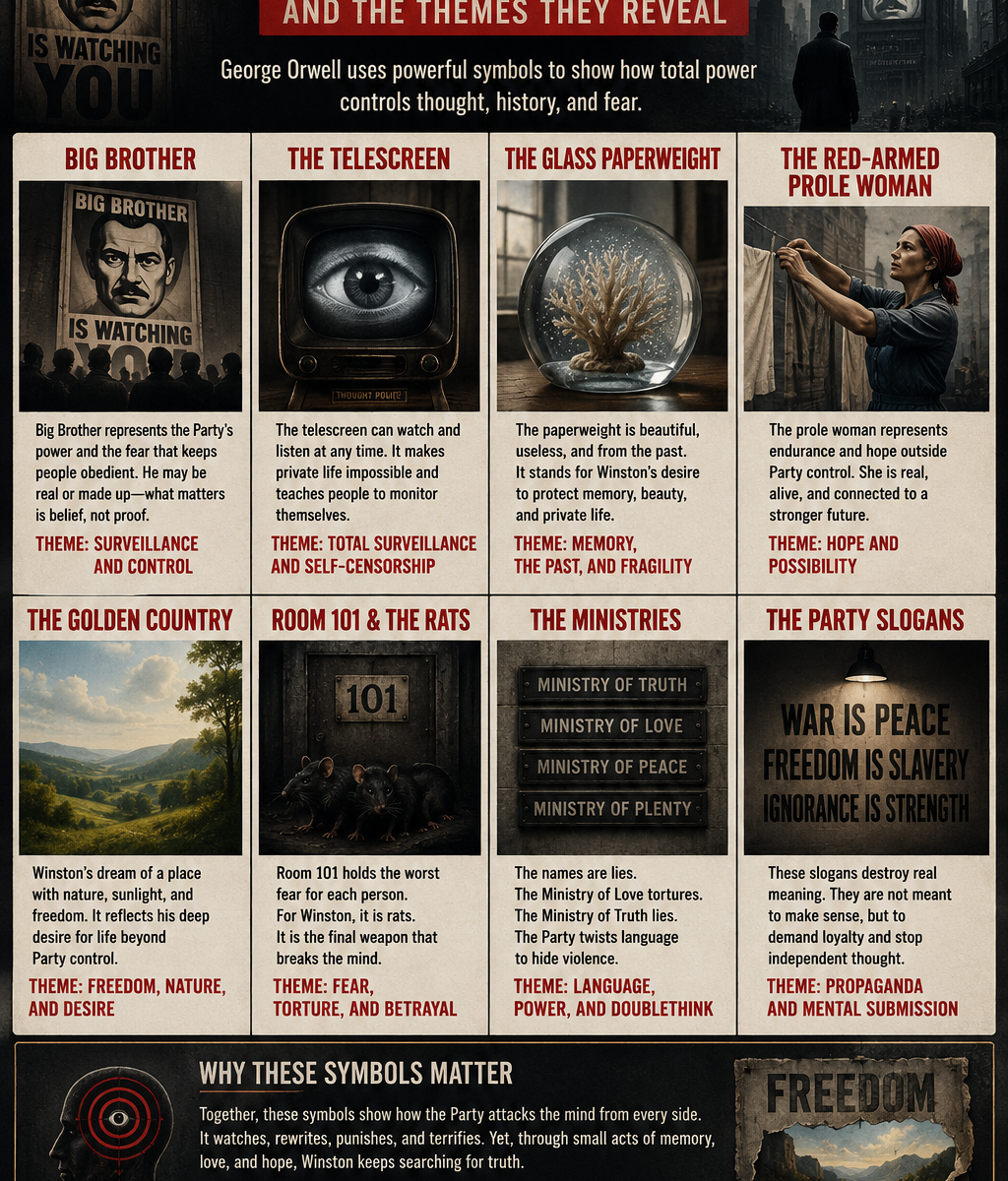
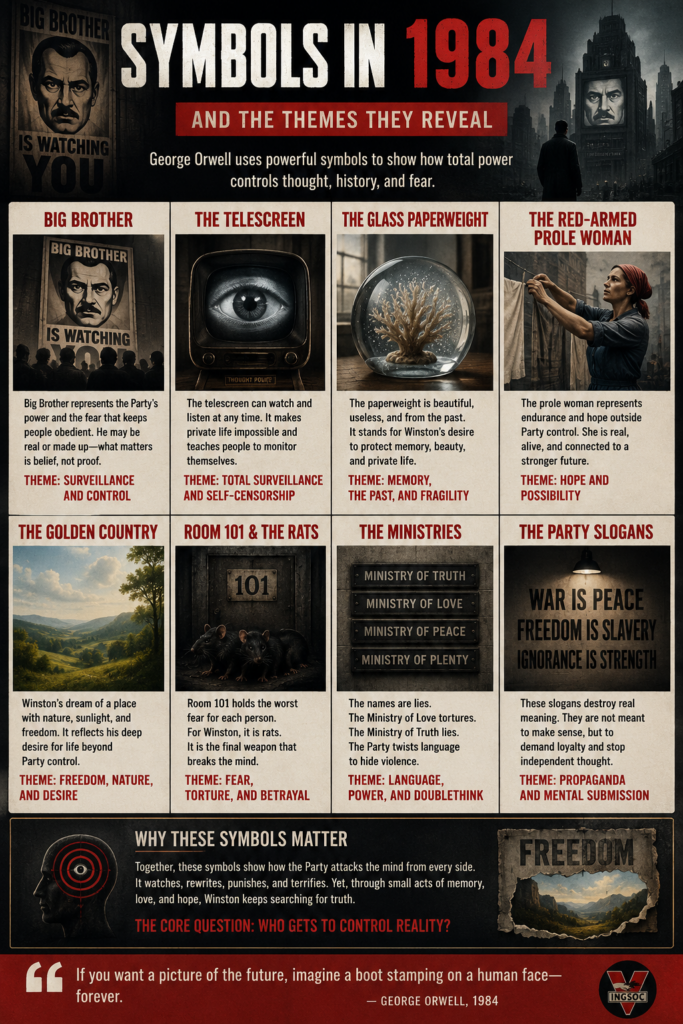
Big Brother stands for the Party’s power and the fear that keeps people obedient.
The famous poster says, “Big Brother is watching you.” This image appears across the city and makes people feel watched even when no one may be there.
Big Brother may be a real person, or he may be a made-up figure. That uncertainty is part of the point. The Party does not need proof. It needs belief.
As one of the central symbols in 1984, Big Brother connects to the theme of surveillance. He also shows how a government can replace family, faith, and personal loyalty with loyalty to the state.
The Telescreen and Total Surveillance
The telescreen turns private space into public property.
Winston’s telescreen can send out Party messages, but it can also watch him. He cannot fully turn it off. Even his face and body can betray him.
This symbol matters because it makes control feel constant. The Party does not only punish crimes. It hunts for thoughts, doubts, and small signs of rebellion.
The telescreen also connects to the theme of self-censorship. Winston learns to hide his feelings because the world around him has no safe corner.
The Glass Paperweight and the Lost Past
The paperweight shows Winston’s desire to protect beauty, memory, and private life.
Winston buys the glass paperweight because it feels useless in the Party’s world. It is old, delicate, and connected to a time before constant control.
The piece of coral inside the glass seems sealed away from history. Winston imagines his room above Mr. Charrington’s shop in the same way. It feels like a small world where he and Julia can exist apart from the Party.
When the Thought Police smash the paperweight, the meaning becomes clear. The Party can break private dreams as easily as glass.
This is one of the most painful symbols in 1984 because it links memory to fragility. The past can matter deeply, but it can also be destroyed.
The Red-Armed Prole Woman
The prole woman symbolizes endurance and a hope that exists outside Party control.
Winston watches her as she hangs laundry and sings. She is not rich or powerful, but she seems alive in a way Party members are not.
Her body, voice, and daily work suggest strength. Winston starts to believe that the proles may hold the future because they have not been fully emptied by Party life.
This symbol connects to the theme of hope. Orwell does not make that hope simple, though. The proles have numbers, but they lack political awareness.
The Golden Country
The Golden Country represents freedom, natural life, and desire without fear.
Winston dreams of a place with grass, sunlight, and open space. It feels like the opposite of London, where rooms are watched and language is policed.
When Winston later meets Julia in the countryside, the setting echoes this dream. For a short time, nature seems to offer a space beyond Party control.
Yet the Golden Country is never fully safe. As with many symbols in 1984, it shows both hope and danger. Freedom exists in Winston’s mind, but the Party works to reach even there.
Room 101, Rats, and Fear
Room 101 symbolizes the final weapon of the Party: personal terror.
O’Brien tells Winston that everyone knows what waits in Room 101. It is the worst thing in the world for that person. For Winston, it is rats.
The rats are not just animals. They represent panic that cannot be argued with. Winston can resist pain for a time, but pure fear breaks the part of him that loves Julia.
This symbol connects to the theme of betrayal. The Party does not only want Winston to obey. It wants him to give up the person he loves most.
The Ministries and Party Slogans
The false names of the Ministries show how language can hide violence.
The Ministry of Love deals with torture. The Ministry of Truth spreads lies. These names are cruel because they force people to accept the opposite of reality.
The Party slogans work the same way. Their purpose is not clear thought. Their purpose is mental submission.
These are important symbols in 1984 because they connect language to power. If the Party can control words, it can weaken a person’s ability to resist.
Why Symbols in 1984 Matter for Themes
The novel’s symbols all point back to the same core question: who gets to control reality?
Big Brother and the telescreen show public control. The paperweight and Golden Country show private hope. Room 101 shows how fear can destroy even deep love.
Together, the symbols in 1984 reveal how the Party attacks the mind from every side. It changes history, watches behavior, twists language, and uses fear when all else fails.
For more background on the novel, you can read Britannica’s overview of Nineteen Eighty-four.
How to Write About Symbols in 1984
A strong paragraph should name the symbol, explain its meaning, and connect it to a theme.
Do not stop at saying that Big Brother is a symbol of control. Show how the poster, the watching eyes, and the repeated slogan make people police themselves.
You can use this simple sentence frame: In 1984, [symbol] represents [idea] because [specific detail], which helps Orwell develop the theme of [theme].
For more help with this skill, review our step-by-step post on finding symbols in fiction.
Books to Pair with 1984
These books pair well with Orwell’s novel because they also explore power, language, and freedom.
- Brave New World by Aldous Huxley
- Fahrenheit 451 by Ray Bradbury
- The Handmaid’s Tale by Margaret Atwood
FAQ About Symbols in 1984
These quick answers can help with homework, essays, or class discussion.
What is the most important symbol in 1984?
Big Brother is often the most important symbol because he represents the Party’s total power and constant watchfulness.
What does the paperweight symbolize in 1984?
The paperweight symbolizes Winston’s love of the past and his hope for a private life outside Party control.
What do rats symbolize in 1984?
Rats symbolize Winston’s deepest fear. They also show how the Party uses terror to force betrayal.
Why does Orwell use so many symbols?
Orwell uses symbols to make political control feel personal. The images help readers see how power reaches into daily life.
Are the symbols in 1984 still relevant today?
Yes. Many readers still connect the novel’s symbols to debates about privacy, propaganda, and truth.
Key Takeaway
The most important symbols in 1984 show how the Party controls people through fear, false language, lost memory, and constant surveillance. Orwell’s images matter because they turn big political ideas into scenes we can feel.


Get the Free Close Reading Worksheet Pack
Join my email list and receive the printable worksheet pack you can use with any novel or poem.
No spam. Just helpful guides for reading literature well.












