

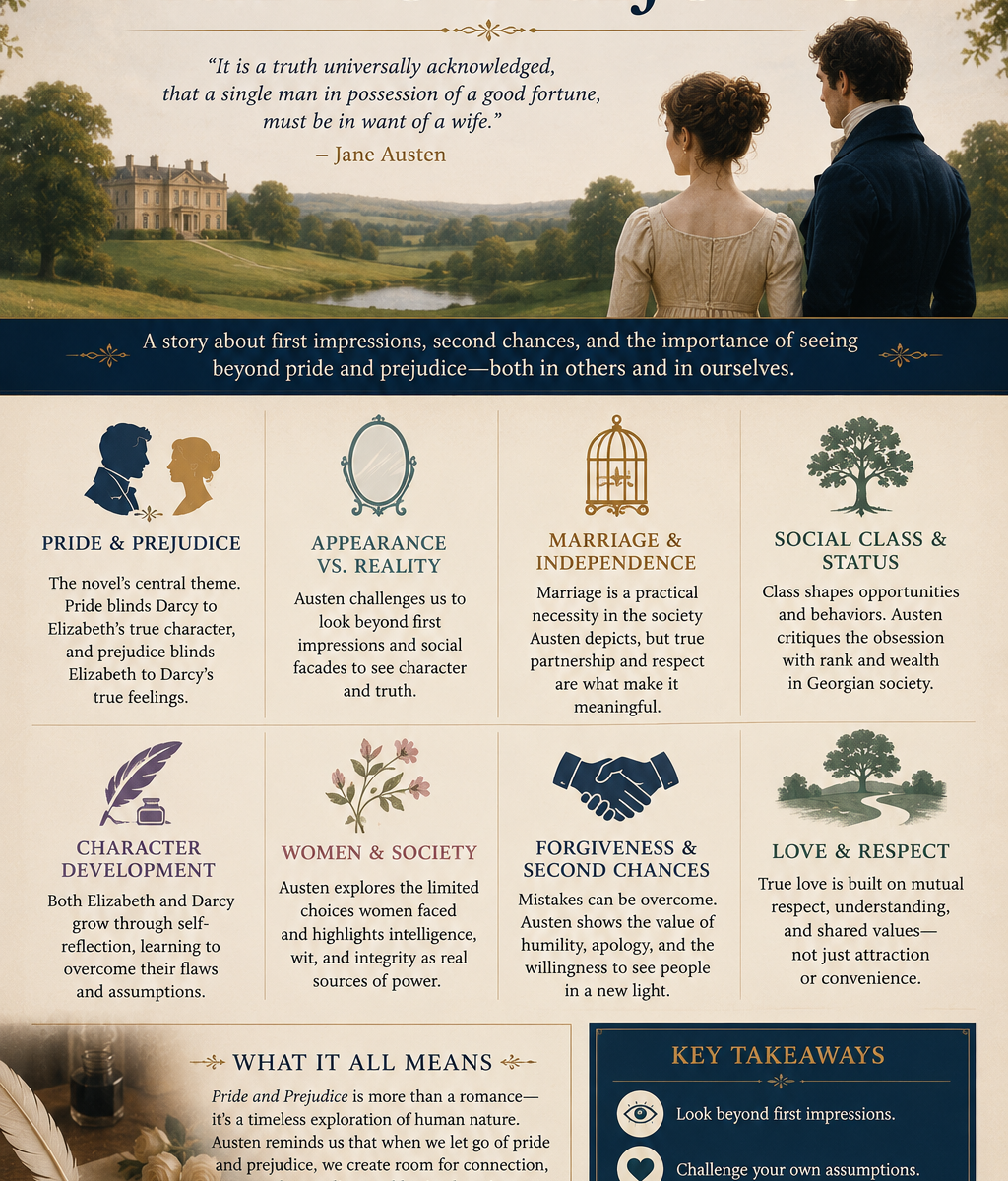
Jane Austen’s novel may look like a love story, but its ideas run much deeper. This guide explains the major themes in Pride and Prejudice so students can see how love, class, pride, and choice shape the whole book.
In this Guide
Use this quick map to find the part you need for class, notes, or an essay.
- Why the ideas matter
- Pride, prejudice, and self-knowledge
- Love and marriage
- Class and reputation
- Money and limited choices
- Gender and power
- Family and education
- Essay tips and FAQ
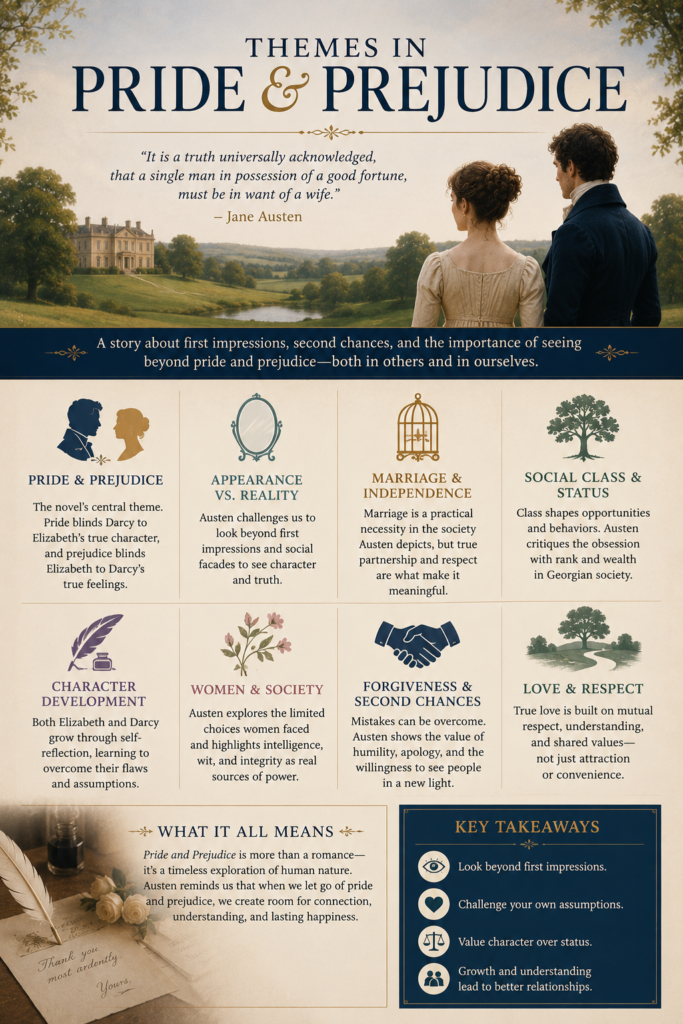
Why the themes in Pride and Prejudice matter
The novel’s themes help explain why a book from 1813 still feels fresh today.
Austen writes about people who judge too fast, protect their social rank, and search for a life with dignity. Those issues still matter in schools, friendships, and families.
The themes in Pride and Prejudice also help students see Austen’s craft. She does not preach. She uses wit, dialogue, and character change to make her ideas clear.
For helpful background on Austen’s life and era, see this overview from Britannica.
Theme 1: Pride, prejudice, and self-knowledge
Elizabeth and Darcy both have to face the truth about themselves.
Pride is not always bad in the novel. A person needs self-respect. But Darcy’s pride makes him cold, while Elizabeth’s confidence makes her judge him too quickly.
Prejudice means more than unfair dislike. It also means forming an opinion before you know the facts. Elizabeth believes Wickham because he seems charming. Darcy misreads Elizabeth’s family and social rank.
A central part of the themes in Pride and Prejudice is the need to grow. Elizabeth changes because she can admit error. Darcy changes because he can see how his behavior has hurt others.
This is similar to Pip in Great Expectations. Pip must learn that status does not equal worth. Both novels ask students to notice how a character’s wrong ideas shape the plot.
Theme 2: Love, marriage, and good judgment
Austen shows that love works best when feeling and reason stay linked.
Marriage is a major plot force in the novel. Mrs. Bennet wants her daughters married because their future is at risk. But Austen does not treat marriage as only a business deal.
Elizabeth refuses Mr. Collins because she knows a loveless match would harm her. Charlotte Lucas accepts him because she wants security. Neither choice is simple.
Another key part of the themes in Pride and Prejudice is the question of good judgment. Elizabeth and Darcy reach a strong love only after they face hard truths.
For quicker review, students can use Pride and Prejudice study resources alongside class notes.
Class and reputation as themes in Pride and Prejudice
Social rank affects how characters speak, marry, and judge one another.
Darcy has wealth and status, so others expect him to act with control. The Bennet family has less rank, so their behavior gets watched more closely.
Lady Catherine believes social class should decide marriage. She sees Elizabeth as beneath Darcy. Austen exposes how cruel that belief can be.
Reputation matters too. Lydia’s elopement threatens the whole family because society blames women more harshly than men. This shows a world where public opinion has real power.
The British Library offers useful context on Austen’s world and works at its Jane Austen page.
Theme 4: Money, security, and limited choices
Money is never just background in this novel.
The Bennet estate is entailed, which means the daughters cannot inherit it. This fact creates pressure from the first chapters.
The themes in Pride and Prejudice often connect love to economics. Characters may want romance, but they also need food, shelter, and respect.
Charlotte’s marriage to Mr. Collins can feel sad to modern readers. Yet Austen asks us to see her reason. Charlotte has few safe options, so she chooses stability.
This does not mean Austen supports every practical match. Instead, she shows how unfair systems limit personal freedom.
Theme 5: Gender and power in daily life
Austen shows how women must work within rules they did not create.
The Bennet sisters need marriage because the law and custom do not give them many paths. Their education, income, and public image all affect their futures.
Elizabeth stands out because she speaks with wit and courage. She refuses to obey Lady Catherine. She also refuses to marry without respect.
Among the themes in Pride and Prejudice, gender may be the easiest to connect to class discussion. Students can ask who has power, who lacks it, and how each character responds.
If you want help tracing those patterns, this guide on how to analyze characters in literature can help you build stronger claims.
Theme 6: Family, education, and influence
Family shapes each character’s choices, but it does not fully control them.
Mr. and Mrs. Bennet both affect their daughters. Mr. Bennet is clever, but he often avoids responsibility. Mrs. Bennet cares about security, but her panic causes trouble.
Elizabeth’s mind has been shaped by reading, talk, and sharp observation. Darcy’s values have been shaped by privilege and family pride.
This is one reason many themes in Pride and Prejudice feel personal. Austen shows that people inherit ideas, but they can still revise them.
How to write about themes in Pride and Prejudice
A strong theme paragraph needs a clear claim and proof from the story.
Do not write only that pride is a theme. Go further. Say what Austen suggests about pride, such as: pride becomes harmful when it blocks empathy and honest self-judgment.
Use a character, a choice, and a result. For example, Darcy insults Elizabeth, then later learns why his pride damaged his chance at love.
When writing about themes in Pride and Prejudice, connect the theme to Austen’s message. A theme is not just a topic. It is an idea the novel develops.
You can also review character analysis strategies to make your theme essay more focused.
Helpful books for deeper study
These books can support essays, class projects, or AP Literature prep.
- Pride and Prejudice by Jane Austen
- Jane Austen: A Life by Claire Tomalin
To understand the themes in Pride and Prejudice more fully, read the novel slowly and track how each major character changes.
FAQ about themes in Pride and Prejudice
These quick answers can help before a quiz, essay, or class discussion.
What are the main themes in Pride and Prejudice?
The main themes include pride, prejudice, marriage, class, money, gender roles, family influence, and self-knowledge.
What is Austen’s message about marriage?
Austen suggests that marriage should include respect and good judgment. Love matters, but so do character and security.
Why does social class matter so much in the novel?
Class affects how people judge each other and who they see as a proper match. Austen shows that this system can be unfair.
How does Elizabeth change?
Elizabeth learns that cleverness does not make her always right. Her growth comes from honest self-reflection.
Is Darcy’s pride completely bad?
No. Darcy has dignity, but his pride becomes harmful when it makes him look down on others.
Key Takeaway
The best way to read Pride and Prejudice is to watch how judgment changes. Austen shows that love and wisdom grow when people become honest about themselves.


Get the Free Close Reading Worksheet Pack
Join my email list and receive the printable worksheet pack you can use with any novel or poem.
No spam. Just helpful guides for reading literature well.












