

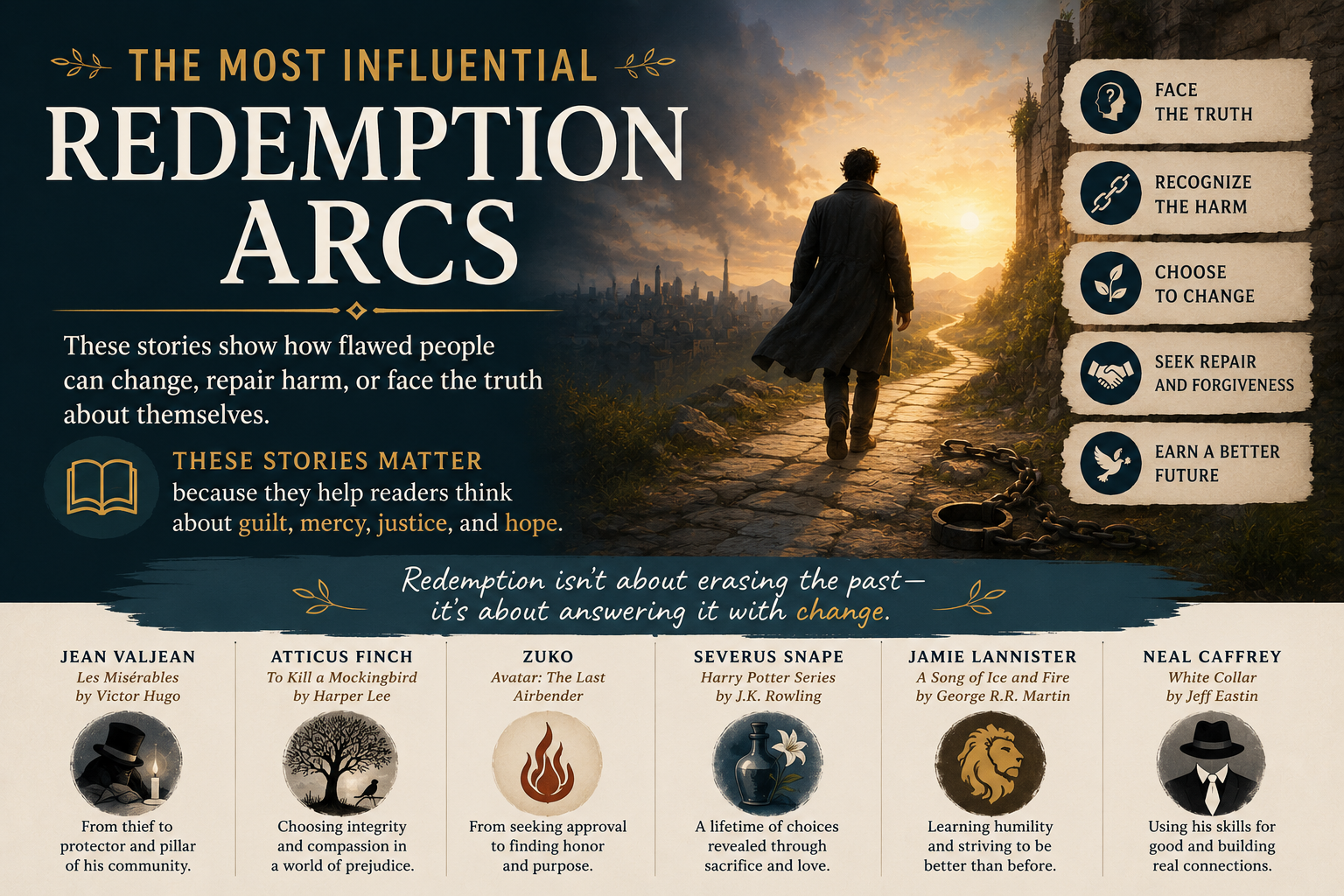
The Most Influential Redemption Arcs show how flawed people can change, repair harm, or face the truth about themselves. These stories matter because they help readers think about guilt, mercy, justice, and hope.
From old classics to modern novels, redemption arcs ask one hard question: can a person become better after doing wrong?
In this Guide
- Why redemption arcs matter
- Classic literary examples
- Themes and symbols
- Modern lessons
- Recommended books
- FAQs
- Key takeaway
Why the Most Influential Redemption Arcs Still Matter
Redemption arcs turn moral failure into a story of change.
The Most Influential Redemption Arcs do not excuse bad choices. They show what happens when a character sees the damage they caused and tries to change course.
This is why students often meet these arcs in English class. They give readers a clear way to study character growth, conflict, theme, and moral choice.
A strong redemption arc usually has a few key parts. The character causes harm, faces a crisis, feels the weight of guilt, and makes a choice that proves real change.
That final choice matters most. A character is not redeemed just because they feel sorry. They must act.
Most Influential Redemption Arcs in Classic Literature
Classic literature gives us some of the clearest examples of moral change.
These Most Influential Redemption Arcs have lasted because they feel honest. The characters do not become perfect overnight. Their change costs them something.
Ebenezer Scrooge in A Christmas Carol
Charles Dickens gives readers one of the most famous redemption stories ever written. Scrooge starts as cold, greedy, and cruel to the less fortunate.
After visits from the ghosts, he sees his past, present, and possible future. These visions force him to face the lonely life he has built.
Scrooge changes because he chooses kindness while he still has time. His redemption feels joyful, but it also comes from fear, shame, and self-knowledge.
For background on Dickens and his work, see Britannica’s overview of Charles Dickens.
Jean Valjean in Les Misérables
Victor Hugo’s Jean Valjean begins as a man marked by prison and poverty. After he steals silver from a bishop, the bishop protects him instead of turning him in.
That act of mercy changes Valjean’s life. He becomes a man who helps others, even when it puts him at risk.
Valjean’s arc shows that redemption is not one moment. It is a lifetime of hard choices.
Sydney Carton in A Tale of Two Cities
Sydney Carton starts as bitter and wasted. He sees himself as a failure with little purpose.
His final act changes how readers see him. By giving his life to save another man, he turns regret into sacrifice.
Carton’s redemption is tragic, but it is powerful. He cannot fix his whole past, yet he can give his life meaning.
Severus Snape in the Harry Potter Series
Snape is one of modern literature’s most debated redemption arcs. He is cruel, secretive, and often unfair.
Yet his hidden loyalty reveals a more complex person. His choices do not erase his harm, but they show a long struggle with guilt and love.
This is why Snape remains important in classroom and fan debates. His arc asks whether sacrifice can balance past cruelty.
Themes and Symbols in Redemption Arcs
Redemption stories often use symbols to show inner change.
Light and darkness appear often in redemption arcs. A character may move from shadow into light, which can show moral growth or new hope.
Journeys also matter. A road, a prison, or a return home can show that change takes effort. Jean Valjean’s movement through France reflects his search for grace and safety.
Names can carry meaning too. When a character takes a new name, it may show a new self. Valjean becomes Monsieur Madeleine, which points to his attempt to live beyond his prison past.
Time is another key symbol. In A Christmas Carol, the ghosts use time to teach Scrooge. The past brings regret, while the future offers warning.
If you want to sharpen your close reading of symbols, imagery, and word choice, try our guide on how to read Emily Dickinson. The same skills can help you study longer novels.
Modern Lessons from the Most Influential Redemption Arcs
Redemption arcs still shape how readers talk about justice and change.
The Most Influential Redemption Arcs are not simple “good guy” stories. They often ask if people deserve a second chance after real harm.
This question feels modern because people still debate it in schools, courts, families, and online spaces. Literature gives readers a safer place to think through the problem.
Some arcs stress forgiveness. Others focus on responsibility. The best ones do not make the answer too easy.
That is why redemption arcs work well in essays. You can ask what the character did wrong, what they learned, and whether their final choice truly repairs anything.
Recommended Books with Powerful Redemption Arcs
These books are strong choices for students who want deeper examples.
- A Christmas Carol by Charles Dickens
- Les Misérables by Victor Hugo
Both books show redemption in a clear but serious way. They also give students rich material for theme, character, and symbolism essays.
For shorter practice, pair a novel with poetry study. A poem can train you to notice small details that reveal change. Our post on reading Emily Dickinson is a useful place to start.
FAQs About the Most Influential Redemption Arcs
What are the Most Influential Redemption Arcs in literature?
The Most Influential Redemption Arcs often include Scrooge in A Christmas Carol, Jean Valjean in Les Misérables, and Sydney Carton in A Tale of Two Cities.
What makes a redemption arc believable?
A believable arc shows guilt, effort, and real change. The character must act in a way that proves they have learned from the past.
Is redemption the same as forgiveness?
No. A character may seek redemption without being fully forgiven. Forgiveness depends on others, while redemption depends on moral change.
Why do teachers assign books with redemption arcs?
These books help students study character growth, theme, and conflict. They also lead to strong essay topics about justice and mercy.
Key Takeaway
The Most Influential Redemption Arcs remind us that change is possible, but never cheap. Great literature shows that redemption requires truth, action, and the courage to become someone better.


Get the Free Close Reading Worksheet Pack
Join my email list and receive the printable worksheet pack you can use with any novel or poem.
No spam. Just helpful guides for reading literature well.












